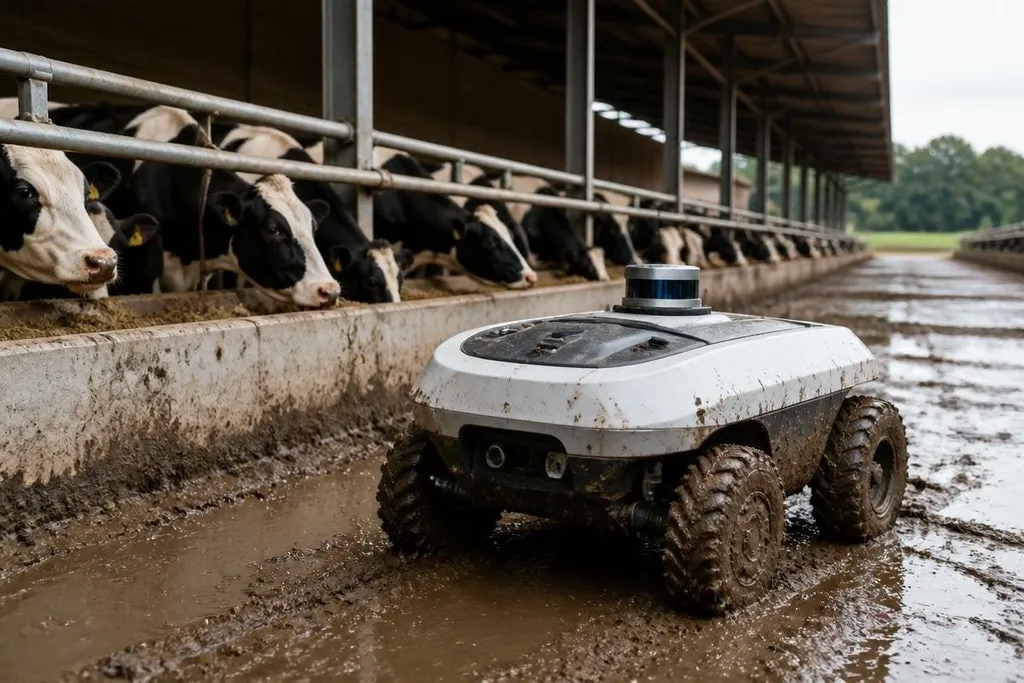
A robot that works in a clean test pen may still fail beside a muddy feed trough. For farmers, the useful question is whether a system can repeat one job safely, through heat, dust, animals, and long workdays.
This article looks at how to judge the global race to build livestock robots when the public record does not yet include enough shared field data.
Quick read
- A useful comparison needs named farms, task results, service records, and prices.
- Milking, feeding, cleaning, and animal checks place different demands on robots.
- A strong video proves that one run worked; it does not prove daily farm service.
The job comes before the robot
Livestock automation covers several jobs, and each one needs a different machine. A milking system must handle animal movement and udder position.
A feed robot needs repeatable travel, accurate dosing, and safe movement near people and animals. A cleaning robot faces wet floors, waste, and blocked routes.
That makes a single race table hard to trust. A robot may perform well at feed delivery and have no useful role in milking. Another may inspect animals with cameras but need a person to check every alert before action.
The first test is task fit. A farm manager should name the job, the work area, the hours per day, and the result that would justify the cost. “Better livestock robots” is too broad to guide a purchase.
What field proof should show
A moving gripper proves the motors run. A farm needs results that hold through repeated shifts. Livestock robotics coverage from Robot24.com can tie a maker’s claim to the animal type, farm site, task, and time in service, so you can judge the robot beyond a staged demonstration.
The useful record starts with the site. It should name the farm, the animal type, the task, and the period of operation. It should also state how much work the robot completed without a person taking control.
Service data matters just as much. A farm needs to know how often the robot stopped, why it stopped, how long repairs took, and which parts need regular replacement. A machine that works for one week tells you less than one that keeps working through a full production cycle.
Cost needs the same care. The purchase price may leave out installation, site changes, software fees, training, and service visits. A fair comparison uses the full cost over a stated period and measures it against labor hours saved or work completed.
Where the hard limits sit
Animals do not follow fixed routes. A cow can block a doorway, a group can change direction, and a wet surface can reduce wheel grip. The robot must detect these changes, stop safely, and recover without creating extra work for staff.
Farm buildings create their own problems. Narrow lanes, low light, dust, water, gates, and uneven ground can affect cameras, LiDAR, motors, and wireless links. A system built for one layout may need new maps or hardware at another farm.
Human oversight also has a cost. If staff must watch a live feed, clear small blockages, or approve each animal alert, the robot may shift work rather than remove it. That can still help, but the farm needs the real task list before it counts the benefit.
A buying check for farm managers
Use these questions before comparing companies or signing a pilot agreement:
- Name the task: record the exact job, work area, and daily schedule.
- Set the result: choose a measure such as feed accuracy, cleaning time, or alert rate.
- Count human work: include loading, checks, recovery, training, and repairs.
- Ask for failure logs: request stop counts, causes, repair times, and missed tasks.
- Price the full system: include installation, network work, service, software, and replacement parts.
- Define the exit: agree on the result that ends the pilot or supports a wider order.
This check also helps separate a research trial from a production tool. A trial may prove that a robot can perform a task under controlled conditions. A production tool must keep doing that task when the barn is busy and the floor is dirty.
What happens next
The race will become easier to judge when makers publish farm names, operating periods, failure rates, human intervention time, and full prices in a common format. Until then, each claim needs its own test plan rather than a place on a global leaderboard.
I'd wait for farm records before treating a livestock robot as ready for broad use. The deciding number is not how quickly it moves in a video; it is how many paid work hours it completes before a person has to step in.